Cooking mushroom risotto isn’t just about stirring rice; it’s a ritual of layering flavors, building a rich, umami broth from humble mushrooms that slowly infuses the dish. I love the meditative rhythm of it—adding broth little by little, waiting for that gentle crackle, watching the rice transform from starchy to creamy. It’s a quiet kind of magic that turns simple ingredients into something deeply satisfying.
This recipe is a small reminder that patience and intention matter. Each step, from sautéing the mushrooms to stirring the rice, feels like a small act of care. It’s about creating something worth the wait, a dish that rewards you with a complex, earthy aroma and a velvety texture that sticks to your spoon. There’s a quiet joy in knowing that the best flavors come from giving your time.
Mushroom risotto is also a comfort, a dish rooted in tradition but endlessly adaptable. It’s perfect for cozy nights when you want something nourishing but not fussy. And honestly, it’s a kind of culinary meditation—an unpolished, honest process that makes every spoonful feel like a small victory.
Focusing on the process of building flavor through layered mushroom broths and umami-rich ingredients, this recipe emphasizes the meditative act of slow, intentional cooking as a way to turn humble mushrooms into a deeply satisfying dish.
Layered Flavors in Every Stir
- The earthy aroma of sautéed mushrooms always takes me back to my grandmother’s kitchen, where simple ingredients felt like treasures.
- There’s a quiet thrill in slowly building flavor with each ladle of broth, almost meditative as the rice transforms into something creamy and inviting.
- I love how mushroom risotto turns humble mushrooms into a dish that feels rich and indulgent, even when made with pantry staples.
- Stirring this dish feels like a small act of care, a way to slow down and focus on the gentle magic happening in the pan.
- Sharing a bowl of mushroom risotto always sparks nostalgia—reminding me of cozy nights and simple, honest comfort food.
The story behind this recipe
- This mushroom risotto recipe was born out of a lazy Sunday afternoon, when I had a bowl of wild mushrooms and a restless urge to do something slow and honest in the kitchen. I wanted something that would celebrate the earthy, meaty qualities of mushrooms without drowning them in heavy cream or cheese. It’s a dish that reminds me to enjoy the process, not just the end result.
- I remember the first time I made this for friends, and how the aroma of sautéed mushrooms filled the apartment, making everyone pause and breathe it in. That quiet moment of anticipation, stirring the rice, feeling the grains absorb every bit of broth and flavor—that’s what keeps me coming back to this dish. It’s about building layers of flavor, one gentle step at a time, and savoring each spoonful.
- heading: ‘The story behind this recipe’
Trivia and Historical Notes
- Mushroom risotto has roots in Northern Italy, particularly in regions like Lombardy and Piedmont, where mushrooms grow abundantly in the forests.
- The dish traditionally used dried porcini mushrooms, which were prized for their intense, smoky umami flavor, especially in winter months.
- Risotto itself originated in Northern Italy as a way to stretch grains during times of scarcity, turning humble rice into a luxurious dish with slow cooking.
- In Italy, mushroom risotto is often made with wild foraged mushrooms, reflecting a deep connection to local foraging traditions and seasonal ingredients.
- The technique of slowly adding broth and stirring is key to creating the creamy texture that defines authentic risotto, a method passed down through generations.
Ingredient breakdown
- Mushrooms: I love using a mix of cremini and shiitake, their earthy aroma and firm bite add depth. Swap in dried porcini for a smoky punch—soak and chop first.
- Arborio rice: It’s the backbone, creamy and starchy. If you only have sushi rice, rinse well and cook a little longer, but it won’t be quite the same texture.
- Vegetable broth: I prefer homemade or low-sodium for control. Use store-bought if pressed—just keep it warm to avoid shocking the rice.
- Onion and garlic: Sauté until translucent and fragrant—this is where the flavor foundation lives. Skip garlic if you want a milder version.
- Parmesan cheese: Adds richness and saltiness. For a vegan version, try nutritional yeast, but it won’t have that same melt-in-your-mouth quality.
- Butter or oil: I use a neutral oil for sautéing, then finish with a knob of butter for richness—adjust based on dietary needs.
- Fresh herbs: A sprinkle of parsley or thyme at the end brightens everything up. Dried herbs can work, but fresh really wakes the dish.
Spotlight on key ingredients
Mushrooms:
- I love using a mix of cremini and shiitake, their earthy aroma and firm bite add depth. Swap in dried porcini for a smoky punch—soak and chop first.
- Arborio rice: It’s the backbone, creamy and starchy. If you only have sushi rice, rinse well and cook a little longer, but it won’t be quite the same texture.
Broth & aromatics:
- Vegetable broth: I prefer homemade or low-sodium for control. Use store-bought if pressed—just keep it warm to avoid shocking the rice.
- Onion and garlic: Sauté until translucent and fragrant—this is where the flavor foundation lives. Skip garlic if you want a milder version.
Notes for ingredient swaps
- Vegetarian: Use vegetable stock instead of chicken broth for a plant-based version that still delivers deep umami flavor.
- Dairy-Free: Swap Parmesan for nutritional yeast—adds a cheesy note but with a nuttier, less creamy finish.
- Gluten-Free: Ensure rice is certified gluten-free; most Arborio rice naturally is, but double-check labels.
- Mushroom Varieties: Dried porcini provide a smoky depth—rehydrate in warm water, chop, then add with fresh mushrooms.
- Rice Type: Carnaroli is an excellent substitute, with similar creamy qualities but slightly firmer bite if you can’t find Arborio.
- Fresh Herbs: Dried thyme or sage can replace fresh, but add these early in the sauté for more flavor infusion.
- Oil & Butter: Use a light-flavored oil or vegan butter if you want to keep it dairy-free without sacrificing richness.
Equipment & Tools
- Large saucepan or wide skillet: To evenly cook the rice and facilitate stirring.
- Wooden spoon: For gentle stirring and preventing sticking.
- Ladle: To add warm broth gradually without cooling the pan.
- Sharp knife: For chopping mushrooms, onions, and garlic.
Step-by-step guide to mushroom risotto
- Equipment & Tools: Gather a large, heavy-bottomed saucepan or wide skillet for even heat distribution. Have a wooden spoon for stirring, a ladle for adding broth, and a sharp knife for chopping mushrooms and aromatics.
- Sauté mushrooms: Heat 2 tbsp olive oil over medium (160°C/320°F). Add sliced mushrooms, a pinch of salt. Cook until they release moisture, edges turn golden, about 8 minutes. Remove and set aside.
- Sweat aromatics: In the same pan, add 1 finely chopped onion and 2 minced garlic cloves. Cook until translucent and fragrant, about 5 minutes, stirring often.
- Toast rice: Add 1 1/2 cups Arborio rice to the aromatics. Stir for 2 minutes until rice edges look translucent. This step locks in flavor and helps the rice absorb broth.
- Add broth gradually: Pour in 1/2 cup warm vegetable broth. Stir until absorbed. Repeat adding 1/2 cup at a time, stirring continuously, allowing each addition to absorb before the next. Maintain a gentle simmer, keeping the temperature around 85°C/185°F.
- Build flavor layer by layer: Continue adding broth and stirring for about 20-25 minutes. The rice should become creamy and tender but still have a slight bite. Check frequently; if rice looks dry, add a splash more broth.
- Finish with mushrooms & cheese: When rice is just tender, fold in sautéed mushrooms, 1/4 cup grated Parmesan cheese, and a small knob of butter. Stir until glossy and well combined, about 2 minutes.
- Rest & plate: Turn off heat. Cover and let sit for 2 minutes to let flavors meld. Serve immediately, garnished with extra herbs if desired.
Let the risotto rest covered for 2 minutes off heat. Then, serve immediately with a sprinkle of fresh herbs or extra cheese for added flavor and visual appeal.
How to Know It’s Done
- The rice should be creamy yet slightly firm in the center (al dente).
- The broth has been fully absorbed, with a velvety texture coating the rice.
- Mushrooms are tender, aromatic, and well incorporated into the dish.
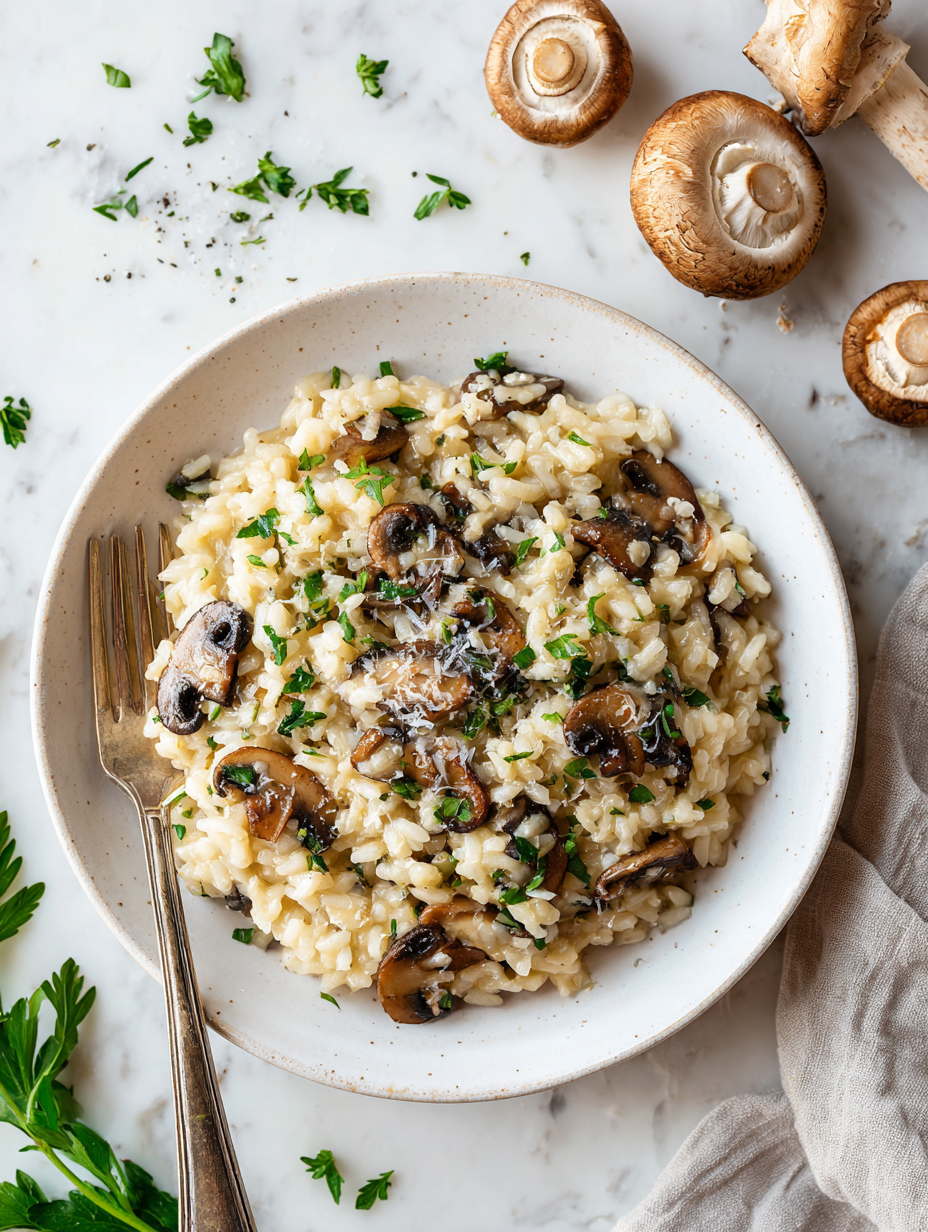
Mushroom Risotto
Ingredients
Equipment
Method
- Heat the olive oil in a large skillet over medium heat until shimmering and fragrant.
- Add the sliced mushrooms and a pinch of salt, sautéing until they release their moisture and turn golden, about 8 minutes. The aroma should deepen, and the mushrooms will develop a nice caramelized edge.2 tablespoons olive oil
- Push the mushrooms to the side, then add the chopped onion to the same pan, cooking until translucent and soft, about 5 minutes. Stir often to release their sweet aroma and soften evenly.2 tablespoons olive oil
- Add the minced garlic and cook until fragrant, about 1 minute, stirring constantly to prevent burning. The kitchen should fill with a warm, earthy scent.2 tablespoons olive oil
- Pour in the Arborio rice, stirring for about 2 minutes to toast the grains lightly; they should look translucent at the edges and emit a faint crackling sound.2 tablespoons olive oil
- Begin adding the warm vegetable broth, about 1/2 cup at a time, stirring gently until each addition is absorbed before adding the next. Maintain a gentle simmer, and continue this process for about 20-25 minutes, until the rice is tender but still has a slight bite.2 tablespoons olive oil
- Once the rice reaches a creamy, velvety consistency and is just tender, stir in the sautéed mushrooms, grated Parmesan, and butter, allowing everything to melt together for about 2 minutes.2 tablespoons olive oil
- Turn off the heat, cover the pan, and let the risotto rest for 2 minutes to let the flavors meld and the texture settle into a luscious, velvety finish.
- Garnish with chopped fresh parsley and serve immediately, enjoying the rich aroma and creamy texture with each spoonful.2 tablespoons olive oil
Tips and tricks for perfect risotto
- Bolded mini-head: Use a wide pan → A larger surface helps the rice cook evenly and prevents overcrowding.
- Bolded mini-head: Stir gently but often → Keeps the rice from sticking and encourages a creamy texture.
- Bolded mini-head: Keep broth warm → Cold broth chills the cooking process; warm broth maintains a steady simmer.
- Bolded mini-head: Toast rice lightly → 2 minutes over medium heat until edges look translucent enhances flavor absorption.
- Bolded mini-head: Check rice texture → It should be tender yet slightly firm in the center, not mushy or chalky.
- Bolded mini-head: Finish with cheese off heat → Adds richness and glossiness; stir in quickly for a velvety finish.
- Bolded mini-head: Rest before serving → Cover and let sit 2 minutes to let flavors meld and avoid runny risotto.
Common mistakes and how to fix them
- FORGOT to stir often → Stir frequently to prevent sticking and ensure even cooking.
- DUMPED all broth at once → Add broth gradually, about 1/2 cup at a time for creaminess.
- OVER-TORCHED rice → Keep heat medium-low; rice should simmer gently, not burn or crackle loudly.
- SKIPPED resting time → Let risotto sit covered 2 minutes before serving for better flavor melding.
Quick fixes and pantry swaps
- If mushrooms release too much water, increase heat to evaporate moisture quickly.
- When rice sticks, add a splash of hot broth and stir vigorously to loosen.
- Splash a little lemon juice if risotto feels flat—brightens flavor instantly.
- Patch overcooked risotto with a spoonful of warm broth, stir until creamy.
- Shield the pan with a lid if broth evaporates too fast, keeping it simmering gently.
Prep, store, and reheat tips
- Prep the broth and chop mushrooms ahead—store in airtight containers for up to 24 hours. The aroma will be richer, and you’ll save time at the stove.
- Cooked risotto can be refrigerated for up to 2 days. Reheat gently on low heat, stirring frequently, until just heated through and creamy again.
- For longer storage, freeze portions for up to a month. Thaw in the fridge overnight, then reheat with a splash of warm broth to restore creaminess.
- Reheated risotto tends to thicken; adjust consistency with a little hot broth or water, stirring until it shimmers and feels velvety.
Top questions about mushroom risotto
1. Can I use different mushrooms?
Use a mix of cremini and shiitake mushrooms for a balanced earthy flavor and firm bite, which enhances the dish’s depth.
2. Why do I need to stir constantly?
Stirring frequently releases the rice’s starch, creating that creamy texture essential for authentic risotto.
3. Why add broth bit by bit?
Adding broth gradually allows the rice to absorb flavors slowly, resulting in a rich, velvety consistency.
4. How should I reheat mushroom risotto?
Reheat leftovers gently over low heat, adding a splash of warm broth to restore creaminess without overcooking.
5. Can I use store-bought broth?
Using homemade or low-sodium broth keeps flavors fresh and controlled, preventing overly salty or dull-tasting risotto.
6. Should I add cheese while hot or off heat?
Finish with Parmesan cheese and butter off heat to add richness, gloss, and a final flavor boost.
7. How do I know when the risotto is done?
Cook the rice until just tender but still slightly firm, about 20-25 minutes, to avoid mushiness and maintain bite.
8. What’s the best pan for risotto?
Use a wide pan to ensure even heat distribution and make stirring easier, promoting a better creamy texture.
9. What heat level should I keep during cooking?
Avoid over-torching; keep the heat at a gentle simmer around 85°C/185°F to prevent burning or sticking.
10. Should I let the risotto sit before serving?
Let the risotto rest, covered, for 2 minutes after cooking to allow flavors to meld and improve texture.
Cooking mushroom risotto is a slow dance with patience, but every spoonful rewards you with a deep, earthy flavor that sticks to your tongue. It’s a dish that feels both humble and special, perfect for cozy nights or when you want to make something from scratch without fuss.
In the end, it’s about the quiet magic of building flavor layer by layer, turning simple ingredients into something truly satisfying. No matter how many times I make it, that creamy, umami-rich bite always feels like a small victory worth savoring.

Hi, I’m Michael Anderson, the voice behind Overreacting To Salt. Yes, the name usually gets a laugh. And no, I am not actually afraid of salt. In fact, understanding salt and flavor balance is what inspired this entire blog.
 The voice behind Overreacting To Salt. Yes, the name usually gets a laugh. And no, I am not actually afraid of salt. In fact, understanding salt and flavor balance is what inspired this entire blog.
Overreacting To Salt is my space to talk honestly about cooking mistakes, kitchen wins, and the small details that make a big difference in flavor. I created it for home cooks who want to understand food better without feeling intimidated.
The voice behind Overreacting To Salt. Yes, the name usually gets a laugh. And no, I am not actually afraid of salt. In fact, understanding salt and flavor balance is what inspired this entire blog.
Overreacting To Salt is my space to talk honestly about cooking mistakes, kitchen wins, and the small details that make a big difference in flavor. I created it for home cooks who want to understand food better without feeling intimidated.